
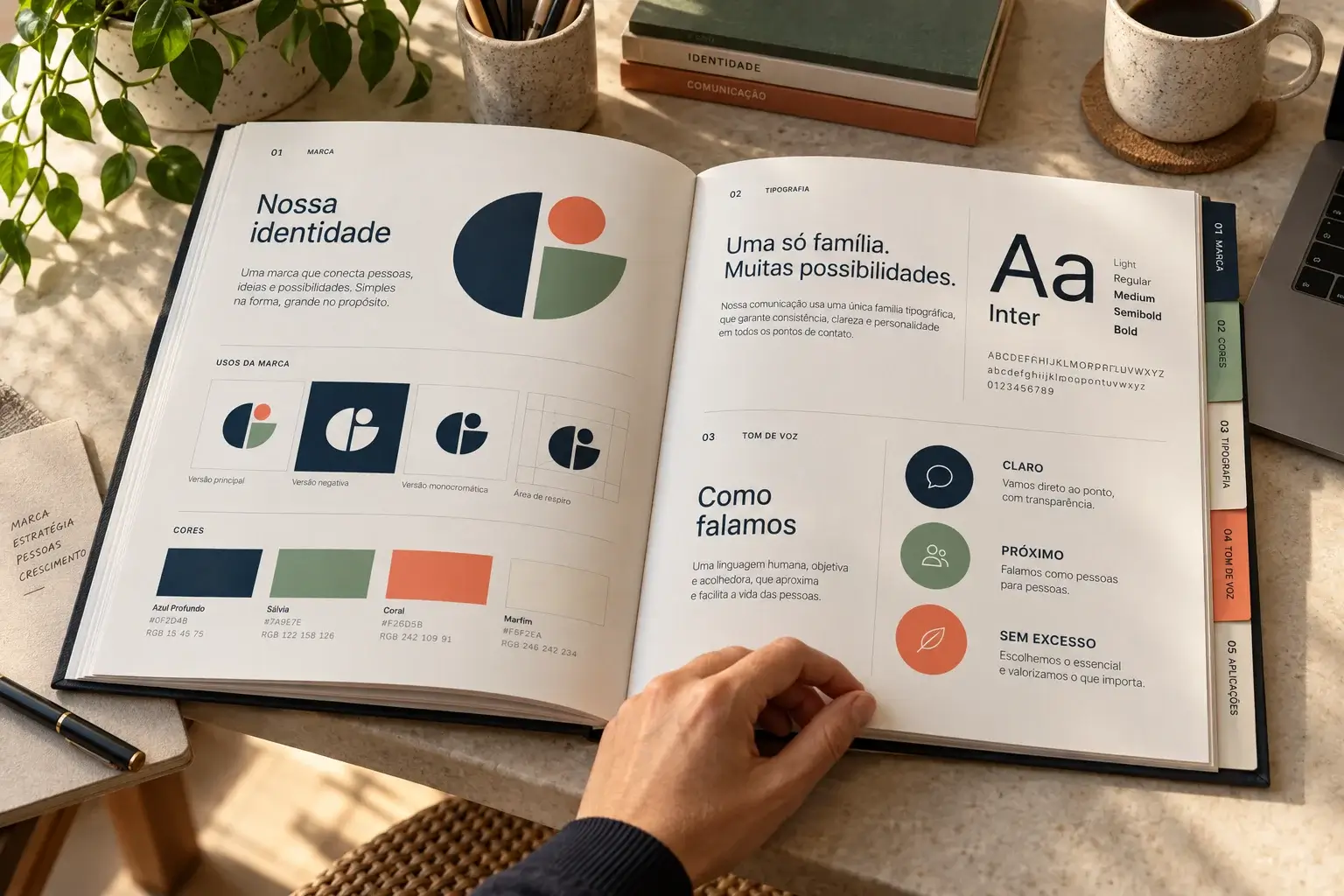
A brand book, also known as brand guidelines, brings together the decisions that shape how a brand presents itself. It helps everyone working with the brand—whether a designer, copywriter, or supplier—use the same criteria.
There’s a common misconception that brand books are only for large companies. In practice, they’re especially useful when a business is small: they reduce rework and prevent every new asset from becoming a fresh decision.
What a Brand Book Usually Includes
According to Neil Patel Brasil’s guide to brand books, common elements include a color palette and the role of each color, typography, photography guidelines, logo applications, image libraries, layout standards, company history, buyer personas, organizational culture, mission, vision and values, communication pillars, a code of conduct, and tone of voice.
That’s a broad list, and not every project needs every section. The useful question isn’t “What should I include?” but “Which decision does this document need to protect?”
Start with What Creates the Most Friction
For most small businesses, a concise brand book has four core parts: a logo with its correct and incorrect uses, a color palette with precise codes, typography with clear hierarchy and usage guidance, and a tone of voice with examples of what the brand says and doesn’t say.
Those four parts solve most day-to-day problems because they’re the decisions that come up again in every social post, business card, or presentation.
Include What Guides Decisions
Beyond visual guidelines, a useful brand book records the mission, values, and communication pillars. When these are written down, content and design decisions become easier to explain. Without them, the manual is just a collection of attractive colors.
Avoid a Brand Book That Sits in a Drawer
A brand book no one consults isn’t useful. If you work on your own, keep it alive by using it for every new asset and updating it only when a decision truly changes. Revising it every week creates work without adding value. (Studio opinion.)
Examples Worth Studying
Large brands have published well-known brand books, including those of Uber, Spotify, Dropbox, and Mailchimp. They’re useful references for structure, but shouldn’t be copied without adapting them. A manual for a company with hundreds of employees needs a level of detail that a solo operation doesn’t.
Suggested Internal Links
- Existing post on visual identity (check whether the title exists on the site).
- Existing post on tone of voice (check whether the title exists on the site).
Frequently Asked Questions
Are a brand book and a style guide the same thing?
Not exactly. A brand book covers the brand as a whole, including its values and positioning. A style guide tends to focus more on visual and writing rules.
Do I need a brand book if I’m self-employed?
It isn’t mandatory, but even a simple document can save time—especially when you need to explain your identity to a client or someone creating content with you.
How many pages should a brand book have?
There’s no ideal length. A concise guide can be a few pages, as long as it covers the decisions you make repeatedly. (Studio opinion.)